
Jacket Potato in the Air Fryer UK
Wash, dry and pierce the potato, then begin within a 190 to 200 degrees Celsius range. Timings vary by potato size and appliance, so check the thickest part and cook for longer if the centre is still firm.
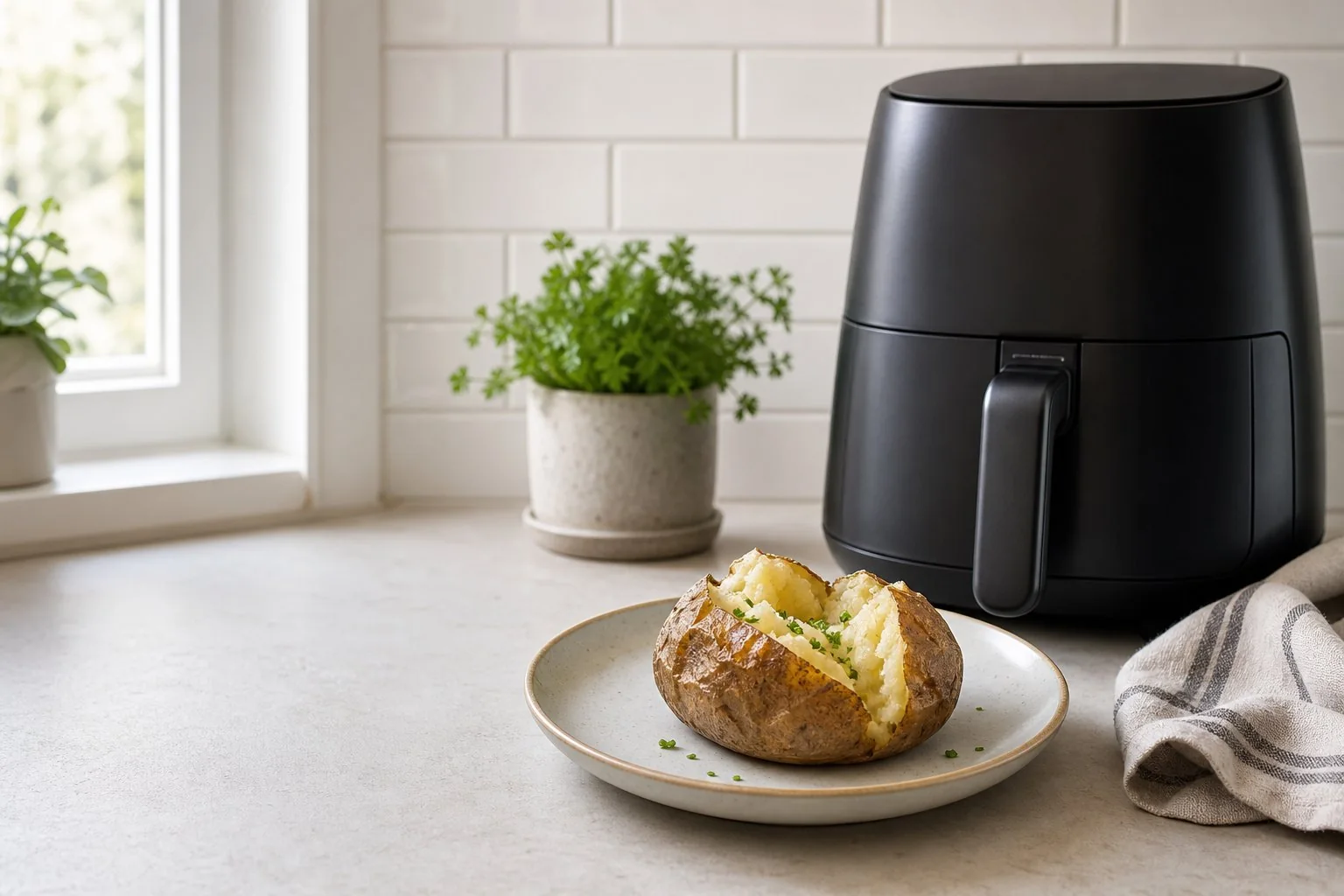
Use size as a checking guide, not a completion promise
Published examples differ even around 200 degrees Celsius. This page uses cautious bands by approximate potato size, tells you to start checking earlier and relies on the centre rather than the timer alone.
Ingredients and equipment
This example batch is a practical reference, not a fixed serving or nutrition claim.
One or two baking potatoes with airflow spaceIngredients
- Baking potatoes of a similar approximate size
- A small amount of rapeseed or sunflower oil, optional
- Salt or other seasoning, optional
- A chosen hot or cold topping, prepared safely
Equipment
- Air fryer and basket
- Clean vegetable brush or clean hands
- Clean tea towel or kitchen paper
- Fork
- Silicone-tipped tongs
- Small sharp knife or skewer for checking
Starting ranges by approximate potato size
These are source-led checking windows, not guaranteed completion times. Large or densely loaded potatoes may need longer.
| Type | Preparation | Temperature | Starting range | Check and adjust |
|---|---|---|---|---|
| Smaller potato | Below about 200 g | 190 to 200 degrees Celsius | Begin checking within 30 to 40 minutes | Turn during cooking; continue in short increments if the centre remains firm. |
| Medium potato | About 200 to 250 g | 190 to 200 degrees Celsius | Begin checking within 35 to 50 minutes | Published examples differ, so check through the thickest part rather than relying on the timer. |
| Larger potato | Above about 250 g | 190 to 200 degrees Celsius | Begin checking within 45 to 60 minutes | Large potatoes may need longer; add short increments until a knife or skewer enters the centre easily. |
Preparation and cooking: step by step
Use the size bands as checking windows, then let the centre texture and appliance determine whether more time is needed.
- 1
Choose similar sizes
Use potatoes sold for baking where practical. Cooking two potatoes of similar approximate weight makes their checking points easier to compare.
- 2
Wash and dry
Wash away visible soil, then dry the skins thoroughly. Dry surfaces take an optional light oil coating more evenly.
- 3
Pierce the skin
Use a fork to pierce each potato several times. Ninja's specified method uses three to five piercings for a 200 g potato.
- 4
Add oil and seasoning only if wanted
A light film of oil and a little salt are optional surface choices. Add oil to the potato, never pour it into the air-fryer pan.
- 5
Leave airflow space
Place the potatoes with space around them rather than wedging them tightly together. Cook in batches if the basket cannot circulate air around the load.
- 6
Cook within the starting range
Use 190 to 200 degrees Celsius as a cautious starting range and use the manufacturer's instructions where they differ.
- 7
Turn and start checking earlier
Turn the potatoes during cooking. Start checking earlier when they are small, the appliance runs strongly or the skin is already browning.
- 8
Check the centre
Insert a small knife or skewer through the thickest part. The centre should offer little resistance. Cook for longer if the centre is still firm.
- 9
Open carefully and serve
Use tongs or heat protection, rest only until safe to handle, then split carefully because hot steam can escape. Add a prepared topping and serve hot.
Troubleshooting the next potato
Change one variable at a time and keep checking the centre directly.
Hard centre
Return the potato to the basket and add short increments. Check through the thickest part again before serving.
Soft skin
Dry the next potato thoroughly, avoid wrapping it in foil and leave more airflow space. Optional oil may change the surface texture.
Uneven cooking
Choose more similar sizes, turn during cooking and reposition potatoes if one side sits close to a heating area.
Split skin
Pierce before cooking and handle gently. A split is not a timer substitute; still check the centre directly.
Over-browning
Check earlier or use the lower end of the temperature range. Do not chase very dark skin as proof that the centre is ready.
Oversized potato
Allow additional short increments, or choose a smaller potato next time. Do not use the medium-potato timing as a completion promise.
Similar sizes
Potatoes of a similar approximate weight are easier to turn and check together.
Airflow space
Leave space around each potato. Split the load when the basket is tightly filled.
Check the centre
A small knife or skewer should enter the thickest part with little resistance.
Golden, not very dark
Use centre texture for readiness and avoid excessive dark browning of the skin.
Serving ideas
Try beans, cheese, vegetable chilli, tuna and sweetcorn or yoghurt and chives.
Handle hot potatoes carefully
Use tongs or heat protection and open cautiously because steam can escape.
Reviewed sources and limitations
Ninja, Philips, Instant Pot and Tesco publish materially different appliance-specific times. The source ledger records those differences instead of presenting one exact duration.
- Ninja Kitchen: Jacket Potato Bar
- Philips UK: Baked potato guidance
- Tesco Real Food: Air-fryer baked potato
- Instant Pot UK: Recipe book
- Food Standards Agency: Cooking and leftovers
Last reviewed: 18 July 2026. Sources accessed: 18 July 2026.
Related guides
Frequently asked questions
Treat the published bands as starting ranges. Timings vary by potato size and appliance, so start checking earlier and cook for longer if the centre is still firm.
The reviewed Ninja and Tesco methods pierce the skin before cooking. This guide follows that cautious preparation and recommends several fork piercings.
No. Oil is an optional surface choice. A small amount can change browning and texture, but it should be applied to the potato rather than poured into the pan.
Insert a small knife or skewer through the thickest part. It should enter with little resistance. A crisp or split skin alone does not prove the centre is soft.
No. It is research-based guidance synthesised from current manufacturer, UK retailer and official food-safety sources.
Follow current FSA storage guidance, reheat only once and make sure it is steaming hot throughout. No exact reheating duration is promised.